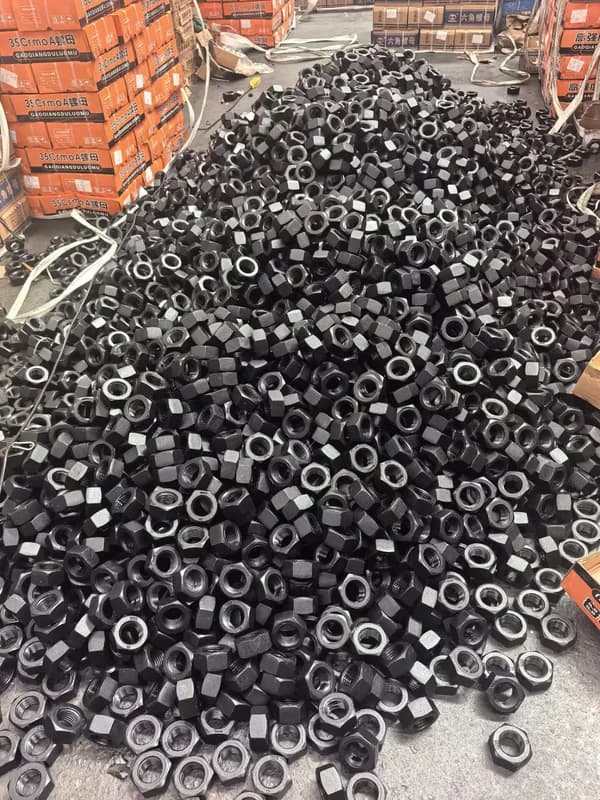

Industrial fasteners and components subjected to vibration often fail due to loosening, fatigue, or material degradation. The primary causes are insufficient preload, thread stripping, corrosion, improper material selection, and design flaws. Understanding these failure modes is critical for engineers selecting fasteners for automotive, aerospace, or heavy machinery applications.
1. Vibration-Induced Loosening
When a bolted joint experiences cyclic transverse loads, the threads can slip relative to each other, causing the nut to rotate loose. This is the most common failure mode in dynamic environments.
Causes
- Insufficient clamp force (preload) due to improper torque or tensioning.
- Lack of locking mechanisms such as nylock nuts, split washers, or thread-locking adhesives.
- Surface finishes with low friction coefficients (e.g., zinc plating without lubricant).
Solutions
- Use prevailing torque nuts (e.g., DIN 985) or serrated flange bolts.
- Apply controlled torque to achieve 75-90% of proof load.
- Consider DIN 25201 double nut assemblies for high-vibration applications.
2. Fatigue Fracture at Thread Roots
Repeated stress cycles cause cracks to initiate at the thread root, especially in bolts with sharp thread profiles or under-torqued joints.
Key Factors
- Stress concentration factor (Kt) at thread roots: rolled threads have higher fatigue strength than cut threads.
- Material hardness: Rockwell C 32-39 is typical for high-strength bolts (grade 10.9).
- Surface defects from manufacturing or corrosion.
Preventive Measures
- Select bolts with rolled threads after heat treatment.
- Use fine pitch threads (e.g., M10x1.25) for better fatigue resistance.
- Apply preload to reduce alternating stress amplitude.
3. Corrosion and Hydrogen Embrittlement
Corrosion reduces cross-section and creates pits that act as stress raisers. Hydrogen embrittlement can cause sudden failure in high-strength steels (≥1200 MPa tensile strength).
Corrosion Types
- Galvanic corrosion between dissimilar metals (e.g., stainless steel bolt in aluminum).
- Crevice corrosion under washers or in threads.
- Stress corrosion cracking in A2 (304) stainless steel under chloride exposure.
Material Selection
| Environment | Recommended Material | Coating |
|---|---|---|
| Indoor, dry | Carbon steel grade 8.8 | Zinc plated (5-8 µm) |
| Outdoor, humid | Stainless steel A4 (316) | Passivated |
| Marine | Duplex stainless steel (1.4462) | None |
| High-strength (automotive) | Alloy steel 10.9 | Zinc-nickel (DIN 50979) |
4. Thread Stripping and Galling
When threads are too soft or engagement length is insufficient, the threads can shear off (stripping). Galling occurs when similar materials (e.g., stainless on stainless) cold-weld under pressure.
Design Rules
- Minimum thread engagement: 1.0 x nominal diameter for steel, 1.5 x for aluminum.
- Use coarse threads (e.g., M10x1.5) for softer materials.
- Apply anti-seize compound on stainless steel threads to prevent galling.
5. Incorrect Grade or Standard Selection
Using a bolt with insufficient tensile strength or wrong dimensional standard leads to early failure. Common mistakes include substituting DIN 933 (full thread) for DIN 931 (partial thread) in shear applications, or using A2 (304) where A4 (316) is required.
Grade Comparison
| Grade | Tensile Strength (MPa) | Typical Application |
|---|---|---|
| 8.8 | 800 | General machinery |
| 10.9 | 1000 | Automotive, heavy equipment |
| 12.9 | 1200 | High-stress connections |
| A2-70 | 700 | Corrosive environments (non-marine) |
| A4-80 | 800 | Marine, chemical |
Always verify that the selected fastener meets the required proof load and yield strength for the joint design. Refer to ISO 898-1 for mechanical properties of carbon steel bolts.
Precision Fasteners Manufacturer supplies a full range of vibration-resistant fasteners including DIN 933, DIN 931, and DIN 985 in grades 8.8, 10.9, A2, and A4 with factory-direct pricing. Contact us for a quote.